Sequenzy vs ActiveCampaign: Which One Fits Your Nurturing Program?
ActiveCampaign charges for the contacts you store; Sequenzy charges for the emails you send. For a big list that receives a few messages a month, that gap is large, but cost is the smaller question. The bigger one is whether your nurturing runs on deal stages in a CRM or on billing and product events.
By Owen Hargrove · Updated 7 Oct 2026
About the prices on this page
Prices for both tools are taken from each vendor's public pricing page and were read on 7 October 2026: sequenzy.com/pricing and activecampaign.com/pricing. The page also says where ActiveCampaign is the stronger choice, because for a sales-led B2B team it often is.
Short verdict, by reader type
Choose ActiveCampaign if you are:
- • A B2B company whose reps work deals in a CRM and want nurture emails to react to deal progress
- • An agency or service business capturing leads on landing pages
- • A team that wants WhatsApp or SMS beside email in one automation
- • A marketer who needs automations with no cap on actions (Plus and above)
Choose Sequenzy if you are:
- • A product-led SaaS billing through Stripe, Paddle or Lemon Squeezy
- • A founder or small team with a large list and a modest sending schedule
- • Someone who wants marketing and transactional email on one bill
- • A team that wants a failed-payment email flow without writing it from scratch
Two concrete cases: a 15-person B2B software company with four account executives working a Salesforce pipeline belongs on ActiveCampaign. A two-person SaaS on Stripe with 8,000 trial users and one newsletter a month belongs on Sequenzy.
What each one charges, at three list sizes
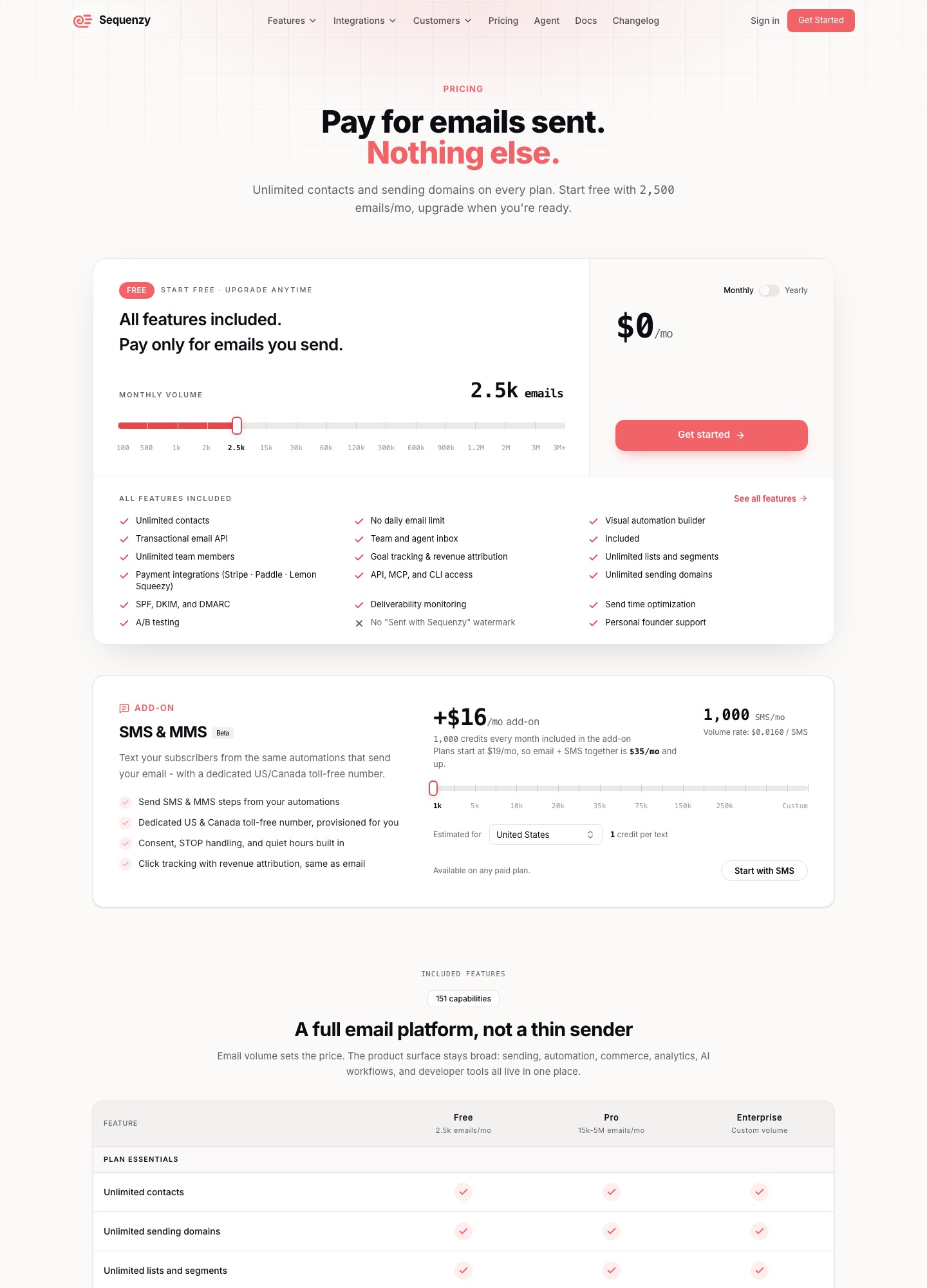
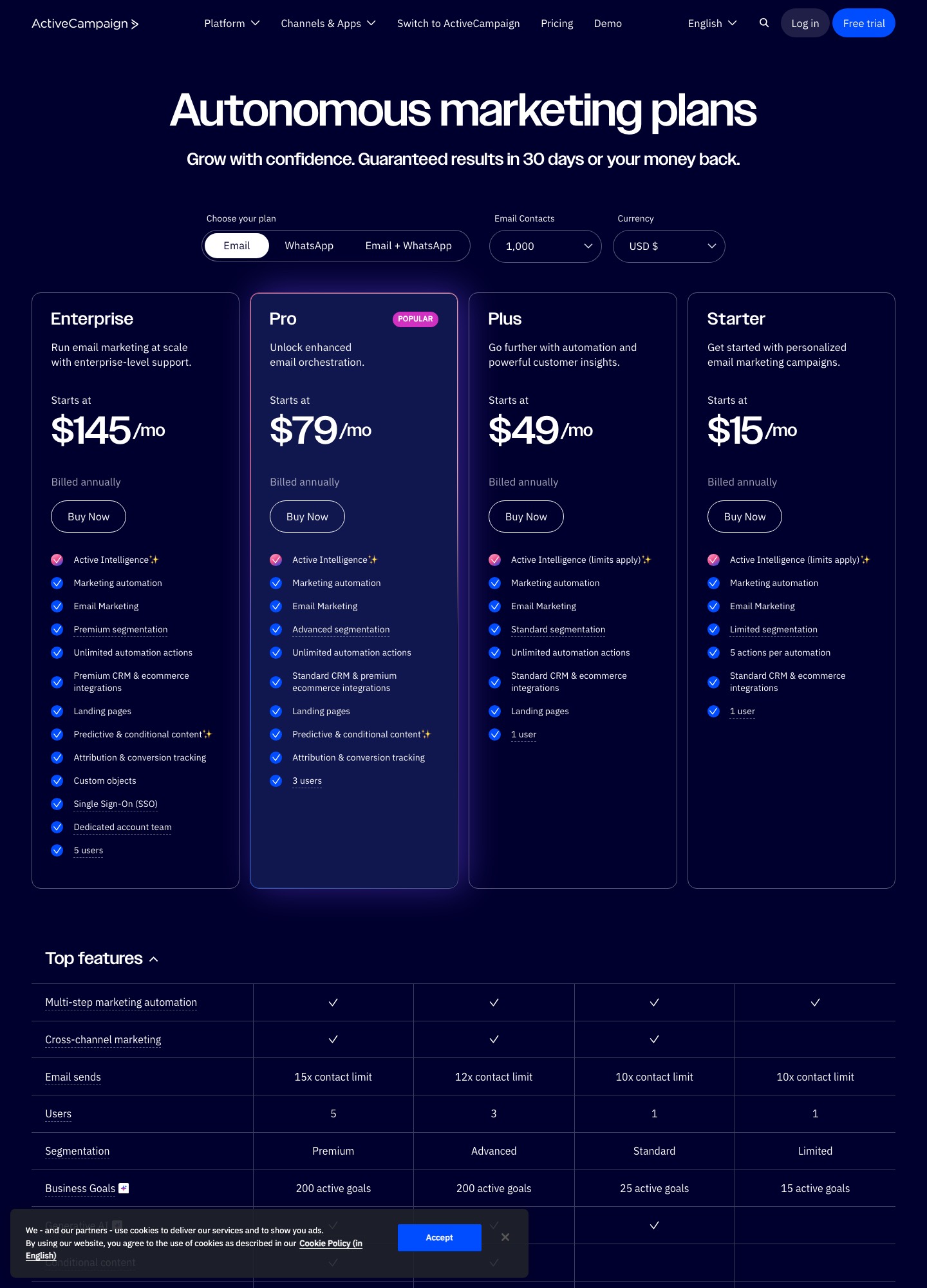
The two tools meter different things, so a fair comparison needs an assumption about how often you send. Sequenzy's pricing page says plans are based on monthly email volume with unlimited contacts and sending domains. ActiveCampaign's pricing page prices by the number of email contacts you select, and its figures are billed annually. The table multiplies list size by a plausible sending cadence to get Sequenzy's volume, then reads ActiveCampaign's plans at the same list size.
| Scenario | Sequenzy (by emails sent) | ActiveCampaign Email plans (by contacts) |
|---|---|---|
| 2,500 contacts, 4 emails a month = 10,000 emails | Fits the 15,000-email step: $19 a month | Starter $39, Plus $95, Pro $149, Enterprise $255 |
| 10,000 contacts, 3 emails a month = 30,000 emails | Fits the 30,000-email step: $29 a month | Starter $149, Plus $189, Pro $375, Enterprise $589 |
| 25,000 contacts, 2 emails a month = 50,000 emails | Needs the 60,000-email step: $49 a month | Starter $391, Plus $389, Pro $629, Enterprise $879 |
Sequenzy steps are the listed 15,000 / 30,000 / 60,000 / 120,000 email plans ($19 / $29 / $49 / $99 monthly, or $205 / $313 / $529 / $1069 a year). ActiveCampaign numbers are the pricing page's contact selector readouts, billed annually.
Three things the table hides. First, the cadence assumption is yours to change: a list of 10,000 mailed ten times a month sends 100,000 emails, which lands on Sequenzy's 120,000-email step at $99, so frequent senders narrow the gap. Past 120,000 emails Sequenzy's slider continues to 300,000 and beyond; read the price there rather than guessing. Second, ActiveCampaign caps sends relative to contacts (10 times the contact limit on Starter and Plus, 12 times on Pro, 15 times on Enterprise), so its price is stable for heavy mailing until you hit that ceiling. Third, at 25,000 contacts Plus ($389) is cheaper than Starter ($391) on the pricing page, so the cheapest tier by name is not always the cheapest tier.
ActiveCampaign's headline of $15 a month applies at 1,000 contacts. At 10,000 contacts the same Starter plan is $149, according to ActiveCampaign's own article on the true cost of email marketing, so budget from the contact selector, not the headline.
Where ActiveCampaign is the stronger tool
- CRM inside the plan. Every ActiveCampaign tier on its pricing page carries standard CRM and ecommerce integrations; Enterprise adds premium CRM integrations, custom objects, single sign-on and a dedicated account team. The vendor also highlights integrations with Salesforce, Microsoft Dynamics, Gmail and Outlook. If your reps need pipeline context to decide who gets which email, this is the reason to choose it.
- Landing pages and capture. Landing pages appear from the Plus plan up. Sequenzy's feature and integration list does not mention a landing page builder, so a lead-capture-first business would need another tool beside it.
- Channel range. The pricing page offers Email, WhatsApp and Email plus WhatsApp plan switches, and ActiveCampaign lists SMS and transactional email as add-ons. Sequenzy's SMS and MMS is a $16 a month add-on that includes 1,000 credits and is labelled beta.
- Personalization and measurement on higher tiers. Pro and Enterprise list predictive and conditional content and attribution and conversion tracking, and Enterprise allows 200 active goals against 15 on Starter.
- More seats as you grow. Pro includes three users and Enterprise five. A marketing team with several editors and a separate ops owner fits that structure.
Where Sequenzy is the stronger tool
- The pricing meter. Contacts are unlimited, so a large free-trial list does not raise the bill; only emails sent do. The free plan covers 2,500 emails a month, and the pricing page states that all features are included on Free with no credit card required.
- Billing events as triggers. Sequenzy's pricing page names Stripe, Paddle and Lemon Squeezy integrations, plus Polar, Creem, Dodo Payments and PostHog. Its homepage describes events starting flows for segments built from plan, MRR and engagement data, and the Stripe line on the pricing page mentions segmenting by MRR and LTV.
- Failed-payment emails. According to Sequenzy's homepage, a Stripe
invoice.payment_failedevent starts a dunning email flow with a card-update page. This is email dunning only. Retry timing for the charge stays in Stripe or Paddle, and this page makes no claim about how many failed payments any email flow recovers. - No gates on the free plan. ActiveCampaign Starter has one user, limited segmentation and five actions per automation. Sequenzy's pricing page lists a visual automation builder, goal tracking and revenue attribution among features included at every volume.
- One platform for both kinds of email. Sequenzy describes transactional and marketing email in one platform with one API, one dashboard and one bill, and lists API, MCP and CLI access on every plan. ActiveCampaign sells transactional email as an add-on.
Limits to plan around on each side
Sequenzy
- • Heavy senders climb the volume steps; read the slider beyond 120,000 emails.
- • No CRM or deal pipeline appears in its published features, so sales-led teams need a separate CRM.
- • The WooCommerce and WordPress plugins are marked beta on the pricing page.
- • Email dunning only: it does not replace the retry settings in your billing system.
ActiveCampaign
- • Every stored contact counts, so a growing free-trial list raises the price even when you rarely email it.
- • Starter allows one user and five actions per automation; unlimited actions start at Plus.
- • Starter stops at 25,000 contacts; at 50,000 the pricing page offers Plus from $609, Pro from $969 and Enterprise from $1,169.
- • Annual billing: the figures above are the annual-billing prices.
How five nurturing jobs divide between them
Trial-to-paid for a self-serve SaaS
Sequenzy fits when the trigger is a Stripe, Paddle or Lemon Squeezy event. ActiveCampaign can run the same sequence, but you carry the trial and payment events in through an integration and build the flow yourself. If trials are sales-assisted (a demo, a rep call), ActiveCampaign's CRM adds context Sequenzy does not hold.
Lead nurture for a B2B service firm
ActiveCampaign. Leads arrive from forms and landing pages, reps move them through pipeline stages, and scoring plus conditional content decide what each lead reads. Sequenzy is built around product and billing events, which a consulting firm does not have. Our B2B lead nurturing strategy page walks through that kind of program.
Card failures and cancellations
Sequenzy has a ready dunning flow tied to invoice.payment_failed and a win-back on subscription cancellation, per its homepage. In ActiveCampaign this is hand-built, which is fine if you already live there.
Webshop follow-ups
Both list Shopify and WooCommerce connections, but ActiveCampaign's ecommerce integrations are part of every plan card, while Sequenzy's WooCommerce plugin is marked beta. For a store, ActiveCampaign is the lower-risk pick.
Welcome series
Either tool works. Sequenzy lists AI-generated email sequences on every plan, which speeds a first draft, and ActiveCampaign gives you more branching and conditional content once the series gets complicated. See trial conversion for sequence timing.
Moving from one to the other
ActiveCampaign to Sequenzy. Export contacts with their custom fields and decide which fields really matter once deal data is gone. Rebuild only the automations that fire on billing or product events; sales-assisted nurture should stay where the CRM is. Because Sequenzy does not price by contacts, you can import the whole list, including long-dormant addresses, but suppress those people from sending so your email count stays low and your reputation does not suffer.
Sequenzy to ActiveCampaign. Count contacts first: every one you import counts toward the selector, so prune unengaged addresses before choosing a tier. Plan for the billing events, which will arrive through an integration rather than a native connector. If you are weighing ActiveCampaign against a bigger suite, our ActiveCampaign vs HubSpot comparison covers that, and the ActiveCampaign alternatives page lists other exits.
Verdict: pick by where your triggers live
If the trigger for a nurture email is something a salesperson does in a CRM, ActiveCampaign is the better product and, once the CRM is counted, a reasonable price. If the trigger is something a customer does in your product or billing system, Sequenzy matches that job directly and costs far less at the list sizes above, because you are not paying to store contacts you rarely email.
Most B2B marketing teams that already run a pipeline in a CRM should start with ActiveCampaign. Most product-led SaaS teams on Stripe should start with Sequenzy's free 2,500 emails and move up its steps only if volume demands it. For a company with both motions, a split setup is more honest than forcing either tool to do the other's job; the email tools for B2B page shows how other teams draw that line.
Frequently asked questions
Is ActiveCampaign cheaper than Sequenzy?
Rarely at the same list size. At 10,000 contacts ActiveCampaign Starter is $149 a month, while a 10,000-person list that receives three emails a month sends 30,000 emails, which is Sequenzy's $29 step. The comparison flips only when you mail very often: Sequenzy bills by emails sent, so a list mailed daily moves up its volume steps while ActiveCampaign's price stays tied to contacts.
Does Sequenzy charge per contact?
No. Sequenzy's pricing page says the plan is based on monthly email volume, with unlimited contacts and sending domains on every plan. The free plan covers 2,500 emails a month; paid steps listed are $19 for 15,000, $29 for 30,000, $49 for 60,000 and $99 for 120,000 emails.
My sales team needs a CRM. Can I still use Sequenzy?
You can, but Sequenzy would sit next to the CRM, not replace it. ActiveCampaign includes a standard CRM on every plan; Sequenzy's published feature list is about email, automation, billing events and integrations, so deal pipelines would stay in a separate CRM connected through its webhooks or Zapier support.
Which one handles failed card payments?
Sequenzy's homepage says a Stripe invoice.payment_failed event starts a dunning email flow with a card-update page. That covers the email side only; retrying the charge is still handled by Stripe or Paddle. In ActiveCampaign you would feed the billing event in yourself, for example through Zapier, and build the sequence by hand.
We have a sales team and a self-serve product. Which tool?
Split by trigger. If most revenue starts with a sales conversation, run nurture in ActiveCampaign next to the CRM. If most revenue starts with a self-serve Stripe checkout, run lifecycle email in Sequenzy. Running both is reasonable when the two motions rarely share the same contact.